








While browsing through record stores in Los Angeles, one thing I really enjoyed was slowly picking through the bargain bins. The sheer number of records listed at $1 was mind-boggling, especially since I live in a country where records are fairly hard to find! Those that you do find in Taiwan tend to be the same albums again and again, I can’t tell you how many copies of Elton John’s Honky Chateau, Blue Moves and Madman Across the Water I’ve come across in the last ten years. If I had a dollar for each copy I’d seen in the used bins, I could retire. Those never need to be repressed, in my humble opinion, not because they aren’t any good (they are), but because there are already so many copies available second-hand that you’d have to be foolish to buy a newly-pressed full-priced copy!
What I found in the L.A. bargain bins instead were lots of great albums that had been on my radar for years but were always too expensive to buy online, especially once you factor in international shipping. One of my favourite finds this trip was a stash of original mono albums by The Dave Clark Five! I owned none of these because they’ve been out of print for years, in fact, prior to 2019, nothing by the Dave Clark Five was available anywhere. A few albums have since been digitally remastered and put on Spotify, but where’s the fun in that when you can get an original mono pressing for a buck?
By hitting several different stores across L.A., I managed to find six original mono pressings and one stereo copy that I bought anyway. Disappointed to find a stereo copy? Actually, yes, and here’s why. The Dave Clark Five recorded and released everything exclusively in mono, except their last three US albums. Any earlier album claiming to be “stereo” is essentially the mono tracks re-processed with excess bass on one channel and superfluous treble and reverb on the other. While this gave the impression of stereo on a rudimentary 60s hi-fi, it sounds pretty awful by today’s standards, particularly bad through modern headphones.
There are only two Dave Clark Five records of earlier material released in true stereo: a UK release called The Best of The Dave Clark Five (Regal Starline, SRS 5037, 1970) and a US-only double LP simply called The Dave Clark Five (Epic, EG 30434, 1971). Both are greatest hits compilations remastered into proper stereo, and whoever did the remastering did a fantastic job. The songs are centred properly, with a nice open sound. A few overdubs appear to be missing (possibly lost during the original mono mastering process), but for the most part they sound fantastic.
It was around this time that the Dave Clark Five masters began getting pulled, and by the mid-to-late seventies the records started going out of print. Dave Clark owns the rights to all the masters and was opposed to reissuing and repackaging without proper compensation, so he pulled everything, and for whatever reason, let it go out of print for nearly 40 years. To the point where most people today have never even heard of a band that actually played quite a big part in the history of the British Invasion. In fact, at their peak, they were as big as the Beatles.
To understand how the mono question fits into all of this, a little context helps. Since the 1950s, rock and roll had always been considered a medium best suited to singles, 7″ 45rpm records. Since most radio stations broadcast in mono and most affordable record players were also mono, singles were almost exclusively released that way. Stereo was considered the realm of the elitist: the classical music aficionado, the high-brow vocal pop enthusiast, the Big Band buff. It wasn’t necessary for the kids buying rock and roll. Most rock bands of the early-to-mid sixties expected their music to be heard in mono, and released it accordingly.
This began to change in the mid-sixties, when the Beatles, the Beach Boys, the Dave Clark Five and others started proving that rock could not only sell albums, but in some cases demanded the longer format. Stereo gradually became the norm for long-playing albums, even as mono remained standard for singles well into the mid-seventies.
It may seem strange to mention the Beatles, the Beach Boys, and the Dave Clark Five in the same breath these days. But it makes complete sense in context. Brian Wilson has always spoken about feeling intense competition with the Beatles. The Beatles were in turn inspired by Pet Sounds. And the Dave Clark Five were right there in the middle of it, one of the first wave of British Invasion bands, taking the Ed Sullivan show by storm just a month after the Beatles’ first appearance (and going on to appear on the show 18 times!). Their single “Glad All Over” was the song that knocked “I Want to Hold Your Hand” off the top of the British charts. At the time, the Beatles went on record to say that the Dave Clark Five were their biggest rival, the band that kept them on their toes and pushing themselves to outdo their previous efforts. (Thanks, Dave!)
The rivalry seemed to go both ways. When the Beatles released A Hard Day’s Night in 1964, directed by Richard Lester, the Dave Clark Five followed suit in 1965 with Catch Us If You Can (released in the US as Having a Wild Weekend), directed by John Boorman.
Unlike the Beatles, the DC5 didn’t play themselves in the film, instead portraying a group of stuntmen, a role Dave Clark was actually well-suited for, having worked as a stuntman before the band took off. The whole band is surprisingly comfortable on camera, and the film itself is well worth seeking out. You should catch it if you can, wink wink. The soundtrack is great, too!
With all of this in mind, finding those early Dave Clark Five records in the bargain bins was genuinely exciting. These were the records that had not only inspired the Beatles to push themselves, but caused them to worry about their place at the top of the charts. Here’s what I found:
Glad All Over (1964) — $5.00
American Tour (stereo, 1964) — $1.00
I Like It Like That (1965) — $1.00
Having a Wild Weekend (1965) — $4.00
Coast to Coast (1965) — $5.00
Satisfied With You (1966) — $4.00
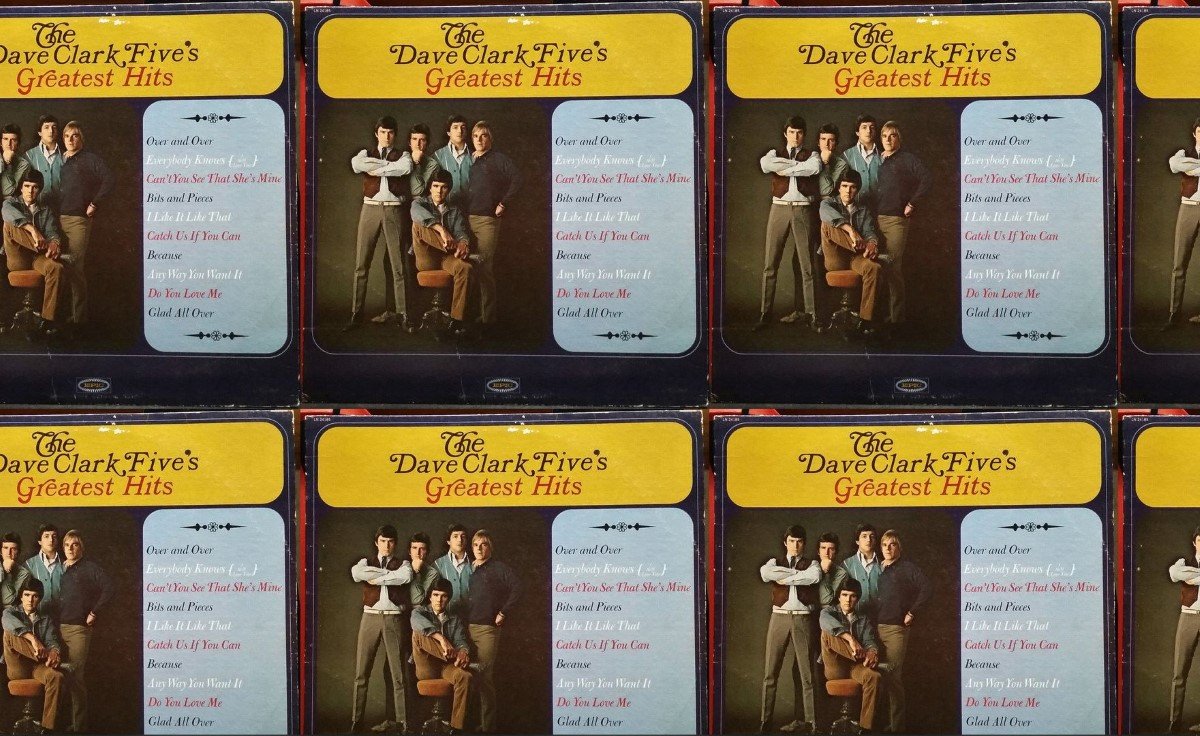
The Dave Clark Five’s Greatest Hits (1966) — $5.00
Most were in excellent condition, some close to near mint after a good clean. The only trouble was Coast to Coast, which skipped on two tracks (luckily I had both on another album!). Twenty-five dollars for seven records was a very nice deal.
So what did I actually discover about the Dave Clark Five? I already knew most of the hits, so no real surprises there, but some of the deep cuts were genuinely great, and I was surprised by how strong the tracks on the earlier albums were. As strong as anything the Beatles had released at that point. I was also interested to discover that the DC5 regularly included instrumentals on their albums, some of them are amazing (“Ol’ Sol” in particular), while one or two were a bit “meh”. Listening to the 1964 and 1965 albums, I could absolutely see why they were giving the Beatles a run for their money.
The 1966 album Satisfied With You, however, was really dull. The early rocking energy had been largely replaced by drab ballads, and it was becoming apparent that they were struggling in the songwriting department, their albums regularly included covers, a practice the Beatles had long since abandoned. The album closer, a cover of “Good Lovin'” (made famous by the Rascals), was decent enough, but not stellar.
There are some Dave Clark Five songs you absolutely must hear in your lifetime, and this is not an exaggeration. For a good time, check out these foot-stomping tracks and you’ll immediately understand what people meant by the “Tottenham Sound”: “Glad All Over”, “Bits and Pieces”, “Any Way You Want It”, “Do You Love Me”, “All of the Time”, “I Know You” and “Catch Us If You Can”. Lead singer Mike Smith had an amazing voice, a deep growl that likely drove every teenage girl into fits of squealing (check out how he handles “I Like It Like That”). And don’t miss “Hurting Inside”, “Can’t You See That She’s Mine”, and the absolutely fantastic “Because”. When I was a kid, I thought those last three were Beatles songs I just couldn’t find on any Beatles record. If for no other reason than those three tracks, you need to hear the Dave Clark Five.
Are they the best thing since sliced bread? No. Were they a great band? Hell yes! The first few albums are strong sixties rock and roll and they still kick ass and take names. I’m keeping my eyes open for more, because despite being unimpressed by Satisfied With You, I know some of the songs from their later albums are just as good as the early stuff, “Tabatha Twitchit” from 1967 and “Red Balloon” from 1968, for starters. Maybe Satisfied With You was just an anomaly. With everything out of print, the only way to know for sure is to keep digging in the bins, and I, for one, am looking forward to the next chance to do just that!
PS: Check my review for this beauty that I found, possibly the strangest entry in the Dave Clark Five’s catalogue: 5×5 (UKVersion)
#MusicBoxTW