








These guys have been on my radar for ages. The first song I heard from them was “Dance With Me” off their album “Bande à Part.” I loved the groove and the lyrics, and when I found out that it was actually a cover of a song by The Lords of the New Church, I was intrigued.
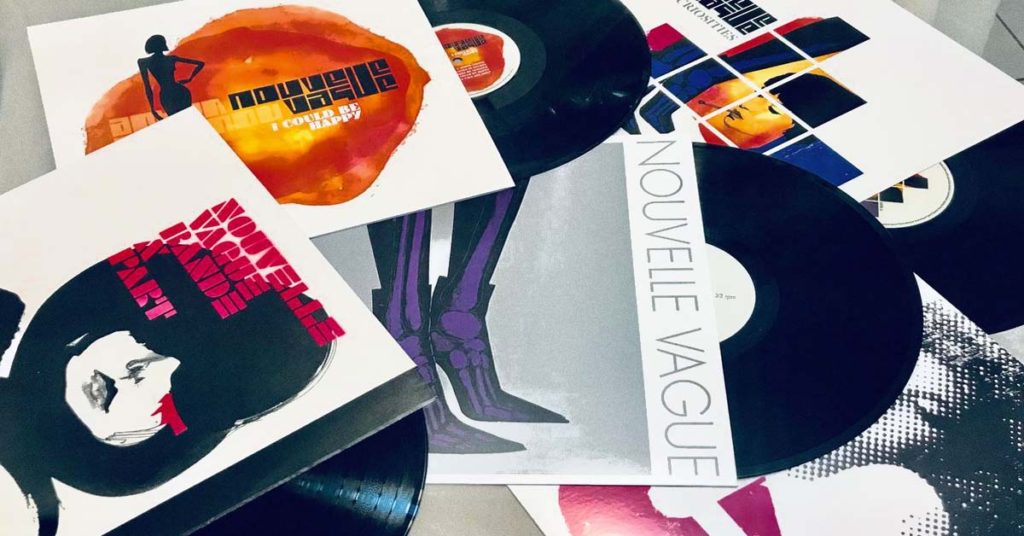
I listened to the rest of “Bande à Part” and I admit I was pleasantly surprised. Of course (you know me) I tracked it down on vinyl!
To be quite frank, before hearing the album, the style and the description held absolutely no interest for me. I am not a fan of jazz or bossa nova. And yet… and yet… there was something so fantastic in these re-imaginings of songs that are so far removed from what you would think of when you think of bossa nova.
These songs were never meant to be a punchline, but rather to showcase the original songs’ musicality. They aren’t being tweaked with and given a Latin flavour just for fun. It’s really obvious that the artists involved have a deep love for these songs, and a deep love for the Latin rhythms they have married them to. The results speak for themselves. Somehow, as impossible and improbable as it sounds, it just works.
How can I be so certain that the songs are not being performed ironically? Why am I so certain that they’re sincere in their love of these songs? How else would they be able to get the creators of these songs to collaborate with them? In 2009, Nouvelle Vague released their third album (appropriately titled “3”), and it features guest vocals from Martin Gore (of Depeche Mode) singing on their version of Depeche Mode’s “Master and Servant”, Terry Hall (of Fun Boy Three and The Specials) singing on their cover of Fun Boy Three’s “Our Lips Are Sealed”, and Barry Adamson (of Magazine) joining them on a cover of Magazine’s “Parade”. To me, this shows that there is a respect for the music, and the original artists know it.
Where did this strange idea come from, you ask. It came from the minds of French musicians Olivier Libaux and Marc Collin. According to Libaux, it was Marc Collin who had the “very strange” idea of covering Joy Division’s “Love Will Tear Us Apart” in a bossa nova style. Finding the challenge more fun and fruitful than expected, the two of them recorded a few more songs. Enlisting an ever-rotating bevy of breathy female vocalists to help flesh out the songs, they soon found themselves with enough material for a first album.
Why these songs? What makes them so special? What makes them work? Aside from the beautifully crafted instrumentation, part of the appeal must be the fact that most of the singers were unfamiliar with the originals, and so their interpretations are wholly sincere, without an ounce of irony. Many of them exude that very French je ne sais quoi that makes even the most blissful melody feel like it’s dying of ennui and in desperate need of a Gauloises and maybe an accordion. The result is like breathing fresh new life into the songs and making them brand new again.
Even the name Nouvelle Vague is far more clever than it appears at first glance. Yes, of course it means “New Wave” in French, and the vast majority of the songs they have covered are considered 70s and 80s New Wave classics. But taking it further than that, “bossa nova” is actually Portuguese for “new wave.” Some people are too clever for their own good.
I honestly can’t recommend them enough. If you are in the mood for something different that will make you smile and maybe even wiggle your hips (don’t worry, no one is looking!), this is a band that will surprise and delight you. These are not just random songs squeezed into a random pseudo-jazz pastiche. The songs Nouvelle Vague has chosen to record are some of the most well-crafted examples of modern pop. These re-imaginings, no matter how different they may sound from the songs that inspired them, always have a recognizable spark or gem that those familiar with the source material will pick up on with an “AH!”. One of the true pleasures of Nouvelle Vague is in hearing the familiar melodies and radically shifted rhythms work together, showcasing the craftsmanship that went into creating the originals.
But where to start? Since their 2004 self-titled debut there have been five further albums and several side projects, not to mention a couple of live albums and even some “unplugged” outings. It’s a lot to wade through. Lucky for you, I know how to swim and I’ve already done it for you.
My suggestion would be to start somewhere near the beginning. Check their second or third albums, where they hit their stride. As lovely as the later albums are, there is the law of diminishing returns to contend with. As they produce more music, the pool of extraordinary songs to choose from shrinks, doesn’t it? There is also the fact that by the time they get to their fifth album, it doesn’t really matter how good the song is … it’s just another jazzy cover version of a pop song. Let’s be realistic and just admit: the concept can (and does) get old, but when it shines it SHINES!
At the very least I hope I have piqued your curiosity and that you will discover something that stays with you.
Recommended albums (in this order): “3,” “Bande à Part,” and “I Could Be Happy.” Each of their offerings has a couple of gems that stand out, but these three are the most delightful, and the ones I feel are strongest from start to finish.
PS: Some of my favourite Nouvelle Vague tracks that deserve a mention: Lords of the New Church’s “Dance With Me”, Echo and the Bunnymen’s “The Killing Moon”, The Psychedelic Furs’ “Heaven”, Violent Femmes’ “Blister in the Sun”, New Order’s “Bizarre Love Triangle”, and B-Movie’s “Nowhere Girl”. Honourable mention goes to one track in particular that makes me laugh every time: Dead Kennedys’ “Too Drunk to Fuck”.
ENJOY!
#MusicBoxTW