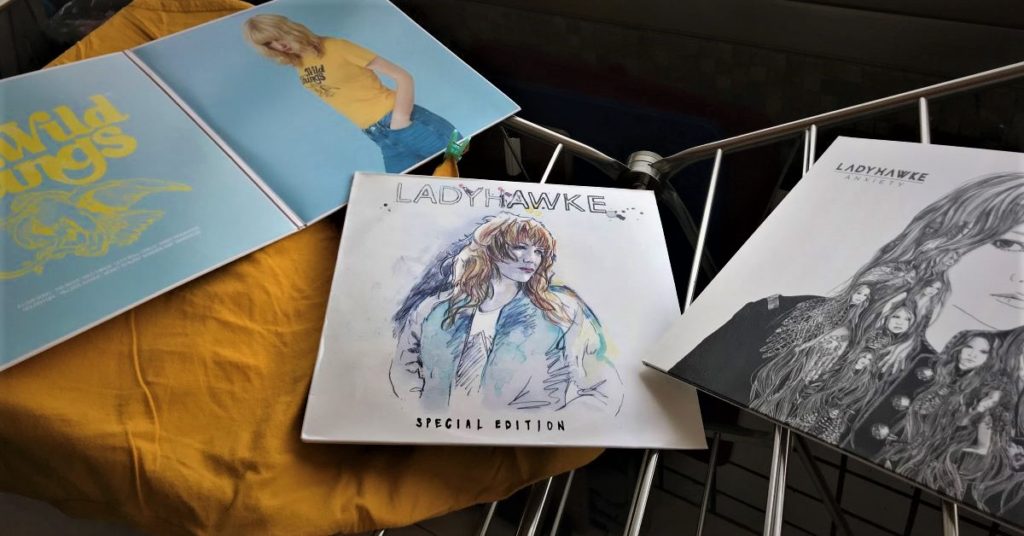









LADYHAWKE
Recently I became aware of a new single from Ladyhawke. This led me to take a brief romp through her discography, reminding myself in the process why I love her!
LADYHAWKE (2009)
Having been part of two professional projects previously (Two Lane Blacktop, 2001-2003, and Teenager, 2003-2006), Ladyhawke (AKA Pip Brown) is a Kiwi multi-instrumentalist who reinvented herself as Ladyhawke in 2009, taking her stage name from Michelle Pfeiffer’s character in the 1985 Richard Donner film of the same name. Her amazing self-titled debut, a beautiful homage to the electronic stadium-rock sound of the ’80s, created small ripples at the outskirts of the music scene … but those ripples eventually became waves as the album hit the top of the charts a year after its initial release. The album yielded five singles and quietly snuck its way to the top of several charts around the world.
The singles featured on the album were “Back of the Van,” “Paris is Burning,” “Dusk Till Dawn,” “Magic,” and (most famously) “My Delirium.”
With five singles taken from the album, you might wonder if the rest was just filler … but songs like “Better Than Sunday,” “Crazy World,” and “Another Runaway” could easily have been follow-up singles to “My Delirium.” Even bonus tracks “Oh My” and “Danny and Jenny,” included on various editions, could possibly have held their own on the charts. “Danny and Jenny” in particular channels Kim Wilde and sounds absolutely ’80s dance-floor ready … or at least ready for the soundtrack to Stranger Things!
The rest of the album is just as engaging, if slightly more moderate in tempo. Tracks like “Love Don’t Live Here,” “Morning Dreams,” “Professional Suicide,” and even “Manipulating Woman” show Ladyhawke wearing her love of ’80s new wave on her sleeve, albeit in a more gentle way. The album is infinitely listenable and has spent many nights on repeat at my house.
It’s a powerful debut, and earned her a nomination for the NME Award for Best Solo Artist, as well as winning the Breakthrough Artist award in both album and single categories at the ARIA (Australian Recording Industry Association) Music Awards in 2009.
My first introduction to Ladyhawke was via the amazing track “My Delirium,” but please don’t ask me how or where I heard it. It has become such a part of the soundtrack of my life that I honestly don’t remember when I first came across it. I just know that once I did, I was hooked. The music video completely blew me away as well. It features the artwork of Sarah Larnach, who also created the artwork for Ladyhawke’s album and singles. The video features long animated segments in Larnach’s soft, vaguely watercolour style of realistic painting.
Ladyhawke’s debut album still blows me away and I really can’t recommend it enough. Every time I go back to it I am constantly amazed at how good it is. Despite being a bit long at 12 tracks (or up to 17 depending on which edition you get), the vast majority of the songs are stellar. Forget the nostalgia factor (which certainly played a role in winning me over) … the songs are modern and engaging, well produced, and catchy as hell.
ANXIETY (2012)
“Anxiety,” the second album from Ladyhawke, arrived in 2012, three years after her debut. Was it worth the wait? Kind of.
Again featuring artwork from Sarah Larnach, this time with inspiration taken from the Beatles’ “Revolver,” the album still held some of the nostalgic groove that her first album showcased, but I found its vibe a bit forced and not quite as naturally exuberant as her debut. It’s not a bad album by any means, but it’s not one I’ll reach for regularly. It showcases a number of great songs, but when an album of ten tracks features three that I’d rather skip and two that are take-it-or-leave-it, that’s not a good sign.
One song in particular, “Cellophane,” features a repeated little whistle sound whose timbre and melody are so reminiscent of Paul McCartney’s “Band on the Run” that it really distracts from the listening experience. I keep finding myself singing “stuck inside these four waaaallls…” every time that little whistle comes in. It’s not a bad song actually, but that choice of instrumentation spoils the experience.
Despite this misstep, tracks like “Girl Like Me,” “Sunday Drive,” “Black White and Blue,” “Blue Eyes,” and “Gone Gone Gone” are fantastic, and three of these were wisely released as singles. Album opener “Girl Like Me” is a great uptempo track to kick things off, and the other non-single I mentioned, “Gone Gone Gone,” has a really nice Doors-meets-Billy-Idol thing going on, which is an awesome way to close the album. My only real disappointment with “Anxiety” is that it feels like too much filler and not enough thriller.
If I had to hazard a guess, I would surmise that this album got struck by the second-album curse that affects so many artists, hence the title. I get the feeling Ladyhawke was trying to do something new, focusing on ’70s retro inspiration rather than the ’80s groove she was more comfortable with. The shift in decades just doesn’t work as well as it could have. Perhaps the concept was a bit forced and the songs suffer from being squeezed into that mould. Whatever was going on, it didn’t entirely work.
Don’t misunderstand me … there is plenty of value on this album, far from it being a write-off. Its high points are, beyond a doubt, career highs. In fact, the music video for “Black White and Blue” (a song I really love) blew me away with its spot-on homage to Faye Dunaway’s character Laura Mars in the 1978 thriller Eyes of Laura Mars, especially the negative whites-of-the-eyes effect used in the original film’s promotional material. If you’ve seen the film, you have to see the music video to believe it. Ladyhawke really captured the feel of the film (I know because I went out and watched the movie as soon as I saw the music video for the first time, haha!).
Despite its shortcomings, “Anxiety” is a nice enough way to spend an hour with Ladyhawke, and worth it for the singles if nothing else. It’s just not a great place to start exploring her catalogue. It suffers from a lack of the laser focus that was so omnipresent on her debut and helped her create such a tight album.
WILD THINGS (2016)
The story goes that back in 2013, Ladyhawke had begun work on a proposed third album, but an entire album’s worth of material was scrapped and she returned to a blank slate to start again from scratch. The result was “Wild Things,” and what a return to form it was.
After the relative disappointment of “Anxiety,” I wasn’t sure what to expect when “Wild Things” dropped in 2016, so I was really pleasantly surprised to find this album bursting with the joy and confidence that were missing on the previous outing. Each one of the eleven tracks stands on its own and there are no fillers.
Right from the get-go, the imagery of the album cover tells us this is a back-to-basics album: very simple and clean, a picture of Pip wearing a yellow T-shirt that says “Wild Things” set against a sky-blue background.
As expected, “A Love Song” and “Wild Things,” the two singles released from the album, are great examples of Ladyhawke’s sound, but album tracks like “The River,” “Let It Roll,” “Chills,” “Hillside Avenue,” and “Dangerous” are fantastic musical excursions. The choppy guitar, driving bass, and soaring keyboards I fell in love with on her first album were back, though a little less obviously nostalgic and more authentically Ladyhawke’s own sound. It sounds like a woman enjoying herself but focused and driven in what she wants to achieve. If you’re tentatively dipping your toe into Ladyhawke’s discography, this album is also a great place to start … from start to finish it rocks.
She still channels her electro-pop heroes (like A Flock of Seagulls, Giorgio Moroder, Erasure, and Kim Wilde) but unlike with her previous effort, the rousing stadium-ready choruses are back and there seems to be an exuberance to her music again. The first album may have some of her better-known tracks, but for a strong album-listening experience from start to finish, “Wild Things” can’t be beat.
TIME FLIES (2021)
Towards the end of 2020, Ladyhawke announced that she was working on a new album. The first fruits of this labour dropped on March 5th in the form of her collaboration with BROODS vocalist Georgia Nott, a fantastic new track called “Guilty Love.” The full album finally dropped on November 19, 2021 and didn’t disappoint. This time around it has a slightly funkier late ’80s/early ’90s vibe with some Bangles and Prince influences.
Standout tracks include “My Love,” “Mixed Emotions,” “Guilty Love,” “Adam,” “Reactor,” and “Walk Away.” Special mention goes to “Think About You” with its funky bass walk, and the title track, which channels the energy of ’80s arena pop rock. The only song I can’t stand is the album closer “Love is Blind,” which suffers from dissonant keyboards (an artistic choice) that make me feel a bit seasick. Overall it’s a very different album from her earlier work, more New Romantic than New Wave, but the creative risks paid off. It’s definitely a classic.
#MusicBoxTW